Bitter is Better: the forgotten taste that helps switch on digestion & appetite control
Posted on 31 August 2026 by Stephanie J Moore
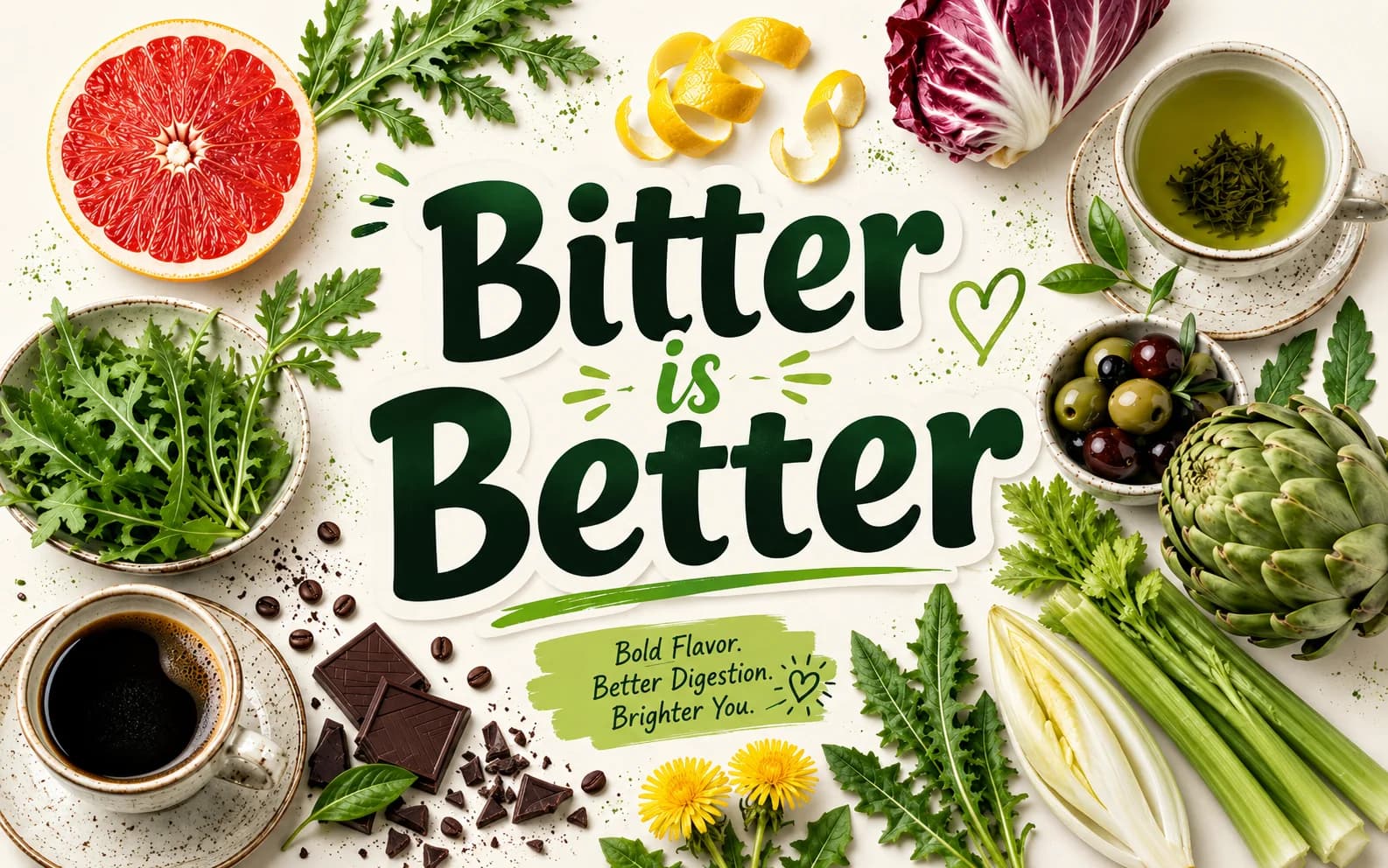
Many people have become devoted to sweetness and crave it morning, noon and night. Sweet breakfasts, sweet drinks, sweet snacks, sweetened yoghurts, sweet protein bars - even foods marketed as “healthy” are often designed to give us that little hit of sweetness our brains have learned to expect. Meanwhile, one of the tastes that humans have consumed for thousands of years has been quietly disappearing from our diets:
Bitter - and that may be a mistake.
Bitter foods don't always give us the instant dopamine-fuelled ‘yum’ of something sweet, but they do something rather interesting. They communicate with the digestive system. In fact, we now know that bitter taste receptors are found not only on the tongue but throughout the gastrointestinal tract, where they are involved in digestive function, gut-brain communication, glucose regulation and appetite signalling.
Perhaps it's time we learned to love bitter again.
Your gut can “taste” your food
Taste receptors were once thought to belong almost exclusively in the mouth. Not any more. We have bitter receptors - known as TAS2Rs or T2Rs - in the stomach and intestine, including on specialised nutrient-sensing cells called enteroendocrine cells. These remarkable cells act rather like surveillance stations within the gut. They continuously assess what is arriving and then communicate that information to the brain, pancreas, stomach and other digestive organs.
The moment food enters the mouth, its taste, smell and even anticipation begin what is called the cephalic phase of digestion. Salivation increases and signals travel through the autonomic nervous system, particularly the vagus nerve, effectively telling the digestive tract:
Food is coming. Get ready.
Food-related sensory stimulation can influence gastric secretion, pancreatic activity, digestive hormones and gastrointestinal motility before the nutrients themselves have even been absorbed.
Then, as bitter plant compounds travel further into the digestive tract, they can interact directly with bitter receptors in the stomach and intestines. And this is where things get particularly interesting.
Bitter foods and your natural “I’ve had enough” hormones
You will probably have heard about GLP-1 because it is the hormone pathway targeted by many of today’s weight-loss drugs. What is not so well known is that your body already makes GLP-1, every day.
GLP-1 is part of an extraordinary network of incretin hormones produced in response to food that signals that you’ve had enough to eat. Alongside it are GIP, PYY and CCK, amongst others. Technically, GLP-1 and GIP are the two principal incretin hormones. PYY and CCK are not incretins, but they are important satiety hormones operating within the same gut-brain conversation.
Together these hormones help coordinate what happens after we eat: insulin secretion, movement of food through the digestive tract, gastric emptying, blood glucose regulation and those incredibly important signals travelling back to the brain telling us: I’ve eaten. I’m satisfied. I don’t need any more food right now.
Research into bitter receptors is particularly interesting because activation of intestinal bitter receptors has been linked with signalling involving GLP-1, PYY and CCK. Human research is still developing and not every bitter compound produces the same response. A systematic review found mixed results across different bitter substances and delivery methods. But other controlled human studies have found reductions in food intake, and one study using a bitter hop extract increased post-meal GLP-1, PYY and CCK while reducing subsequent energy intake. That doesn't make a plate of rocket salad a natural version of a GLP-1 drug. It does, however, tell us something important.
Our appetite isn’t controlled simply by willpower. It is controlled by biology - and food provides instructions to that biology.
Bitter is information
We often talk about food as protein, carbohydrate, fat, vitamins and calories. But food is also information.
Polyphenols, alkaloids, glucosinolates and many of the other phytochemicals that make plants so beneficial to us can also contribute bitterness. For most of human history we would have consumed substantially more wild leaves, herbs, roots and bitter plant compounds than we do today. Modern agriculture and food manufacturing have tended to favour sweeter, milder flavours because they are easier to sell with naturally bitter foods like Brussel sprouts and broccoli being selectively grown to have less of the bitter compounds. Unfortunately, in removing bitterness we may also have removed some very useful digestive signalling.
The big bitter food and drink list
are plenty of delicious ways of bringing bitterness back into everyday food, rather than chewing on some gentian root, which is far too challenging for most people:
Bitter salad leaves and greens: rocket/arugula, watercress, chicory, radicchio, red chicory, endive, Belgian endive, escarole, frisée, dandelion leaves, mustard greens, turnip greens, kale, cavolo nero and some varieties of chard.
Cruciferous vegetables: broccoli, broccoli sprouts, tenderstem broccoli, broccoli rabe/rapini, Brussels sprouts, cabbage, red cabbage, Savoy cabbage, cauliflower, kohlrabi, turnips and mustard leaves. Their glucosinolates contribute some of their characteristic bitter bite.
Other vegetables: globe artichokes, asparagus, celery and particularly celery leaves and cured olives.
Herbs: parsley, sage, rosemary, thyme, oregano, marjoram, bay, tarragon and other strongly flavoured culinary herbs. More concentrated traditional bitter herbs include gentian, dandelion root, artichoke leaf and wormwood.
Spices and seeds: turmeric, fenugreek, cumin, nigella/black seed, mustard seed and some strongly flavoured spice blends.
Fruit: grapefruit, pomelo, Seville/bitter oranges and the peel and white pith of lemons, limes and oranges. Citrus peel is considerably more bitter than the juice.
Cacao: cacao nibs, raw cacao and high-cocoa dark chocolate - the higher the cocoa and lower the sugar, the more genuine bitterness remains.
Nuts: walnuts in particular have a slight bitter/astringent quality from their polyphenols.
Coffee and tea: unsweetened coffee, espresso, green tea, matcha, black tea, oolong tea and yerba mate all provide bitter plant compounds.
Herbal drinks: unsweetened chicory-root coffee, roasted dandelion-root tea, artichoke tea, gentian preparations and other bitter herbal infusions.
Hops: hops are intensely bitter and are increasingly interesting to researchers studying bitter receptors. However, beer is not a health recommendation! Hop extracts and alcohol-free hop drinks provide other ways of using these compounds.
Tonic water: quinine provides tonic water’s characteristic bitter flavour, although many commercial tonic waters contain considerable sugar, so choose carefully. It is also not a reason to consume medicinal quantities of quinine.
There is a wonderful additional advantage to many of these foods. The bitterness is frequently coming from the very polyphenols and phytochemicals we are trying to encourage people to eat more of anyway to support the gut microbiome.
Don’t immediately cover the bitterness up
This matters - if you put rocket on your plate and then bury it underneath a sweet dressing, you have somewhat missed the point. Let your mouth actually experience the bitter flavour. Try rocket dressed simply with extra virgin olive oil and lemon. Have a little radicchio or chicory before your main meal. Drink a small unsweetened green tea. Eat some watercress. Add fresh herbs generously to food.
Allow your taste buds to register the bitterness in the foods and drinks as there may be benefits occurring both from the initial sensory experience in the mouth and subsequently when bitter plant compounds interact with receptors further down the gastrointestinal tract.
What about digestive bitters and Swedish bitters?
This is where traditional herbal medicine becomes fascinating. “Bitters” have been used before meals in many cultures for hundreds of years to stimulate appetite and digestion. Modern digestive bitter preparations commonly contain combinations of plants such as gentian, dandelion, artichoke, angelica, bitter citrus peel and occasionally wormwood, although formulations vary enormously.
Swedish bitters are another traditional herbal mixture. Again, there is no single universal formula and different products contain quite different combinations of herbs.
If you use a liquid bitter preparation, one of its advantages may be precisely that you can taste it. A few bitter drops on the tongue or diluted in a small amount of water before a meal creates that immediate bitter sensory signal before the food arrives. Follow the manufacturer’s dosage instructions rather than assuming more is better.
Be aware that herbal bitters are not appropriate for everyone. Some contain alcohol; others contain herbs with laxative effects, while particular herbs may be unsuitable during pregnancy or for people with certain gastric, gallbladder or bile-duct conditions. Grapefruit and bitter orange ingredients can also be relevant to some medication interactions. If you take medication or have a gastrointestinal condition, check the individual formulation with an appropriately qualified practitioner or pharmacist.
My simple experiment: have a hit of bitter before you eat
Try this for a couple of weeks.
Before your main meals, introduce something genuinely bitter.
It could be a handful of rocket or watercress.
A few leaves of chicory or radicchio.
A sip of dandelion or unsweetened green tea.
A little grapefruit, if compatible with your medication.
Or a suitable bitter herbal tincture.
You don't need a huge quantity. The idea is simply to reintroduce a flavour that has largely disappeared from modern eating. Ideally, have it shortly before your meal and actually taste the bitterness rather than swallowing it unseen in a capsule. Then eat your meal slowly enough to allow the rest of your appetite hormones to join the conversation because satisfaction takes signalling.
And then there is sweet…
Sweetness sends a very different message.
There is an important bit of physiology to clarify here. Sugar does not simply “switch off” GLP-1. In fact, glucose entering the intestine is one of the things that stimulates both GLP-1 and GIP. But that isn't the whole story. Sweet taste and the arrival of rapidly available sugar also engage powerful gut-brain and reward pathways that helped our ancestors recognise valuable sources of energy. In today’s environment, where exceptionally sweet foods are available all day, every day, those same pathways can encourage us to seek the experience again. This is why describing sugar as chemically “addictive” is probably too simplistic, but describing sweet, energy-rich foods as highly reinforcing is entirely reasonable.
One bite so easily invites another.
A diet dominated by refined carbohydrate and sugar can also create an unfavourable environment for the gut microbiome, particularly when that diet is simultaneously poor in fibre and plant diversity. High simple-sugar dietary patterns have been associated with changes in microbial diversity, intestinal barrier function and the balance between different microbial populations.
You will sometimes hear the idea that “sugar-loving microbes make you crave sugar”. There are fascinating gut-brain mechanisms through which microbes may influence eating behaviour, but we do not yet have enough human evidence to say that a particular microorganism is directly commanding you to reach for the biscuit tin. What we can say is that repeatedly feeding ourselves, and therefore our microbial ecosystem, a high-sugar, low-fibre diet can help reinforce a biological environment in which cravings and poor appetite regulation become much harder to control. Once again, food is information.
The next generation of “natural GLP-1” supplements?
There is now enormous commercial interest in finding natural compounds capable of enhancing our own endogenous GLP-1 and satiety signalling. This is hardly surprising. Rather than supplying an external drug that continually stimulates the GLP-1 receptor, researchers are asking whether certain nutrients, fibres, polyphenols and plant compounds can help encourage the body’s own enteroendocrine cells to release more of their natural hormones.
Recent research has investigated non-digestible fibres, polyphenols, berberine, tea compounds and bitter botanicals, amongst others. Bitter hop extracts are particularly interesting: human research has shown increases in GLP-1, PYY and CCK and reduced energy intake, and a 2026 randomised trial reported greater fat loss over 24 weeks in people using a bitter hop nutraceutical alongside lifestyle advice.
Expect to see considerably more supplements appearing with phrases such as “GLP-1 support”, “incretin support” and “natural appetite signalling” over the next few years. Scientists in New Zealand have spent many years researching a particularly interesting example: Amarasate®, a proprietary extract from a specific variety of bitter hops. Rather than supplying an external hormone-like drug, the extract is designed to activate bitter receptors within the gut and stimulate the body’s own production of satiety hormones including GLP-1, PYY and CCK. It is now used in a commercially available appetite-support supplement and recent human research has produced some genuinely interesting results. There is one practical drawback: it needs to be taken around an hour before eating to produce its appetite-regulating effect - probably not terribly convenient for many people. But I think it gives us a fascinating glimpse of where this market is heading.
And there is an important difference between this approach and the weight-loss jabs. Drugs such as semaglutide provide powerful, long-lasting pharmacological stimulation of the GLP-1 receptor, while drugs such as tirzepatide stimulate both GLP-1 and GIP receptors. A bitter extract, by contrast, is attempting to encourage the gut to generate more of its own natural satiety signals, in response to a physiological stimulus. We already know that appetite frequently returns - sometimes very strongly - when GLP-1 drugs are stopped, and weight regain is common. We do not yet know that this is because the drugs actually suppress one’s own GLP-1 production, but it does highlight a very important question: how do we strengthen our own appetite-regulating machinery so that it is working well before, during and after these drugs?
For me, that makes approaches which stimulate endogenous satiety signalling particularly interesting. Rather than simply asking how strongly we can suppress appetite pharmacologically, perhaps we should also be asking how effectively we can help the gut and brain rediscover their own ability to say:
“Thank you. I’ve had enough.”
Some of these emerging supplements will undoubtedly have interesting science behind them. Others will simply have very good marketing. As ever, I would rather start with the physiology.
Chew well, eat slowly and feed the gut properly. Feed your microbes. Eat enough protein, fibre and natural fats. Give your digestive system time to register what you have eaten, and perhaps rediscover something our diets have become strangely short of:
a good hit of bitter.
The Simple Takeaway
Before your next meal, try something bitter.
Taste it.
Give those receptors something to respond to.
Then let your own beautifully sophisticated digestive system do some of the appetite regulating for you.